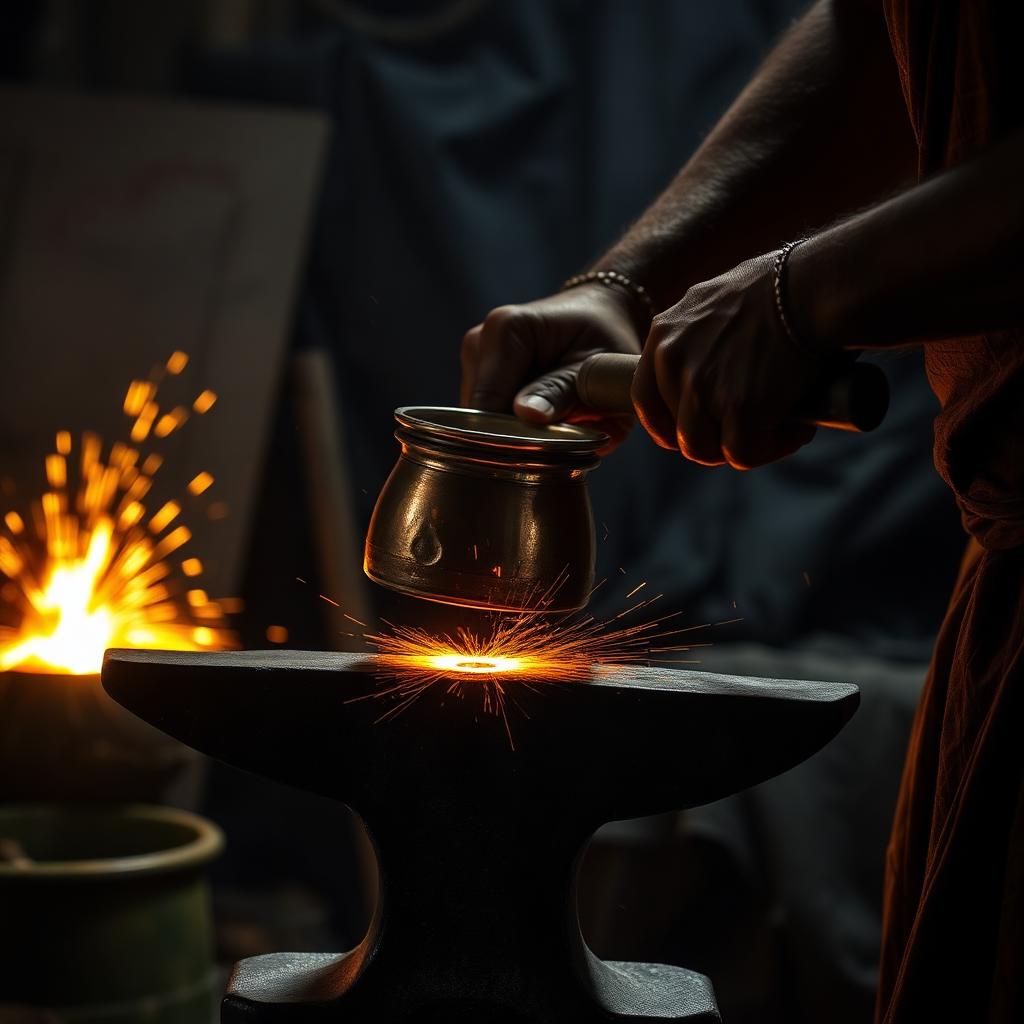
Who are the Thathera?
The Thathera (ठठेरा) are a small community of hereditary metalsmiths who live and work in Jandiala Guru, a town near Amritsar in Punjab. For more than two hundred years, they have hand-hammered utensils and vessels from three sacred Indian metals — tamba (pure copper), pital (brass) and kansa (bell metal). The word thathera itself comes from thath, the sound the hammer makes as it strikes the metal.
In 2014, UNESCO added the Thathera craft to its Representative List of the Intangible Cultural Heritage of Humanity — making it the only Indian craft on that list to date. It sits alongside Japanese Noh theatre, Argentine tango and Mediterranean falconry.
The craft, in five stages
- Alloying. Copper and zinc are melted in a clay furnace to make pital (brass); pure copper sheets are used for tamba vessels. The exact ratio is memorised, never written.
- Drawing. A flat disc is heated red-hot and drawn upward by hand, blow by blow, into a bowl, patila, degchi or lota. No lathe, no press.
- Hammering (thathayi). Two or three smiths sit cross-legged around the vessel and hammer in a rhythm — one strikes, the others rotate. The rhythm is what gives Jandiala Guru its distinctive sound.
- Annealing. The vessel is reheated between rounds so the metal stays workable and does not crack.
- Finishing. The rim is turned by hand, the outside is polished with tamarind and salt (no chemicals), and the piece is stamped with the family's mark.
Why it matters
A hand-hammered pital or tamba vessel is not just a utensil. It is a living archive of Indian metallurgy. The Thathera know how to work copper and brass without the electricity, chemistry or measuring tools most modern factories rely on. If the last workshops close, that knowledge disappears with them.
In 1947, Jandiala Guru had over 300 active Thathera households. Today, fewer than 40 remain. TAMRA works directly with these families — every copper water bottle, every brass masala box, every pital thali we sell is drawn from a flat disc by a Thathera in his own workshop, not by a machine.
How to spot a real Thathera piece
- Visible hammer marks. Uneven, dimpled, warm — never mirror-smooth.
- Weight. A genuine tamba lota or pital degchi is dense; a spun imitation feels tinny.
- Sound. Tap the rim: a hand-hammered vessel gives a low, slow-fading ring. A machine copy gives a bright, short ping.
- Rim. Turned by hand — slightly irregular, warm to the touch.
- Family mark. Most Thathera workshops stamp their pieces with a small symbol. Ask the seller to name the workshop.
From the Thathera's fire, to your home
Every TAMRA piece is a direct commission from a Jandiala Guru workshop. When you drink your morning Tamra Jal from one of our bottles, or serve dal in one of our pital thalis, you are not just using a beautiful vessel — you are keeping a two-hundred-year-old craft, and the community that carries it, alive.